Find · Test · Plan · Watch
Find a setup.
See what it would have paid.
Start from a move you noticed. Find what was different before it, test it on other coins and dates, plan the entry and exits to see what each trade made after costs, then watch for it live.
Research is a work in progress. Estimated release: 1 December 2026. Our goal is to make it a search engine for trading setups in recorded crypto markets. Explore a saved example without signing up
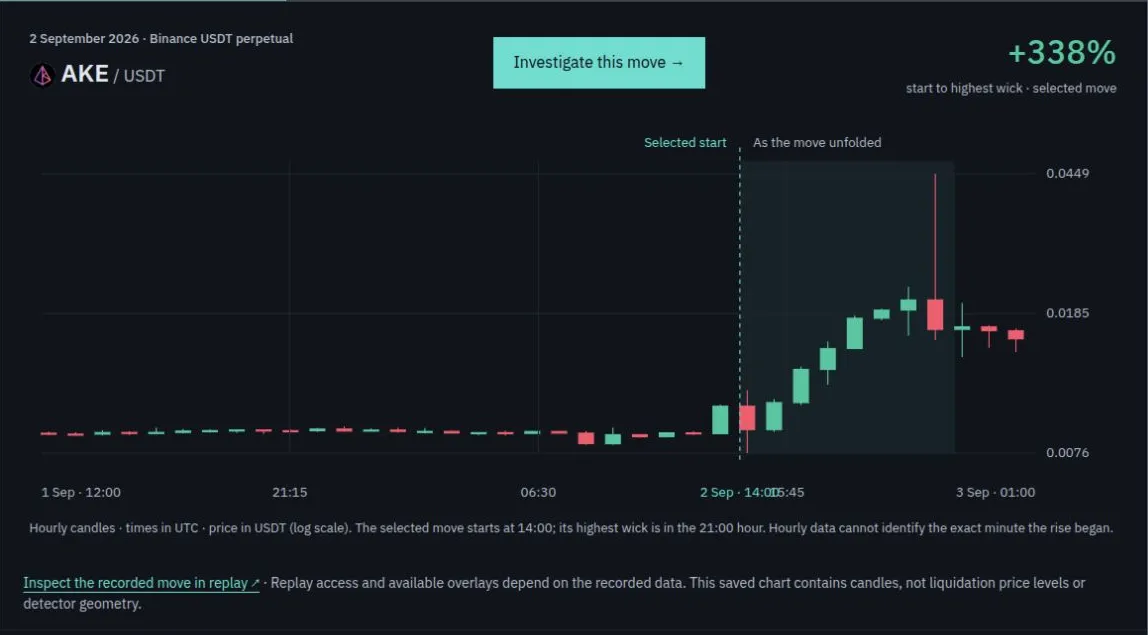
- The move you noticed
- +338% to the highest wick
- Start a study from here
01 · Find
Find what came before.
Point at a move. Research shows which readings stood out before it and turns them into explicit conditions: here, a flat order book, clustered liquidations and a resistance tested three times, all at the same minute. Change any threshold, market or date before you run it. This draft carries the conditions to 71 markets; the result below is the AKE-only test.
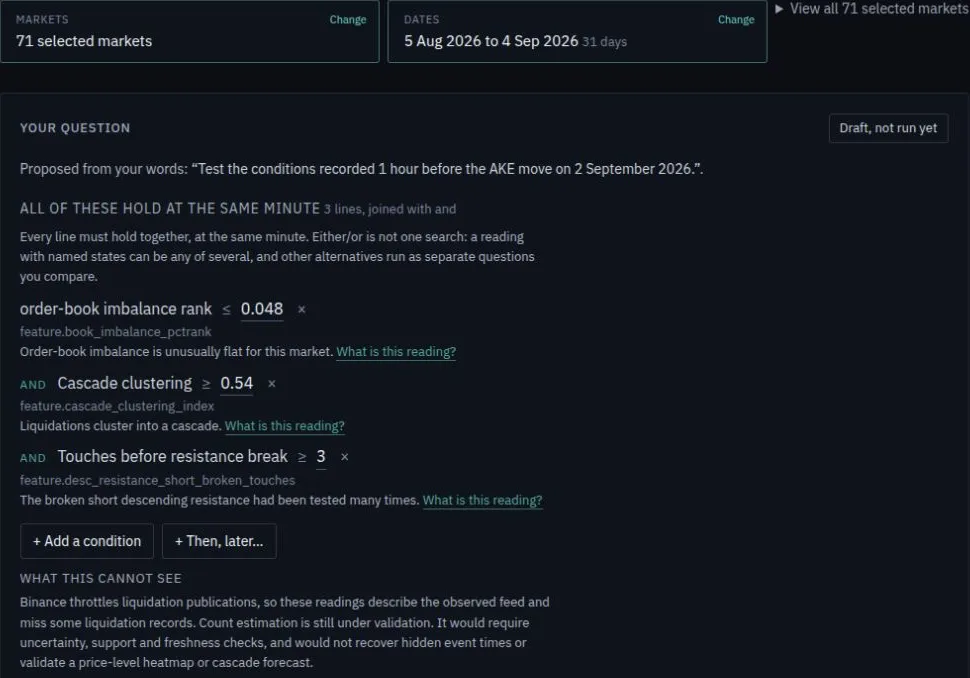
- Three readings, all at the same minute
- Choose the markets and dates
- Add a condition or a sequence
- What the readings cannot see
02 · Test
See what followed, every time.
The conditions appeared 111 times on AKE that month. 11.7% of those minutes closed at least 2% higher 30 minutes later, against 11.2% of all AKE minutes, and 9.9% fell at least 2%. Counts sit beside every percentage. This is how often price moved, not what a trade made: that is the next step.
Explore this saved comparison →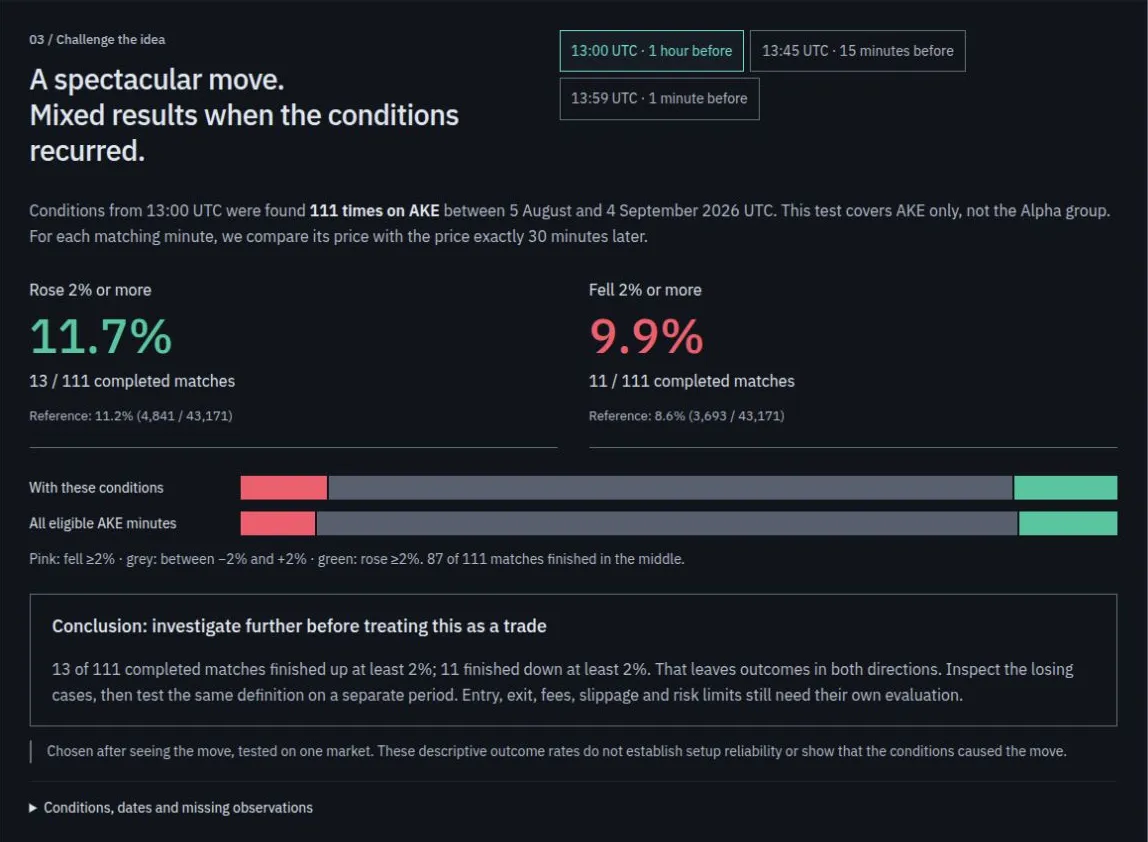
- Matches that rose 2% or more
- The same market, every minute
- Both groups, side by side
- A plain conclusion
03 · Plan
Then see what it would have paid.
Add an entry, a stop, a target or a trailing exit. Every trade is simulated on the recorded prices with fees and slippage, and the answer leads with what a trade made, not how often it won.
Did not pay: -1.7% a trade after costs
Won 30% of 186 trades; at these win and loss sizes (+11.5% / -7.3%) it needed 39% to break even.
Pays: +0.25R a trade
Wins 25% of trades, each win four times the size of each loss. That needs only 20% to break even.
Historical results after fees and slippage, never a forecast; the AKE test omits funding. Every result shows its trade count and how much of the profit the biggest wins supplied.
04 · Watch
Get told when it happens again.
Save the setup and turn on alerts. They arrive in the app and on Discord, and each one links back to the test and its assumptions.
An alert returns you to the saved definition and evidence. It means the conditions occurred again, not that a trade is advisable.
Read the video transcript
Does a sharp jump keep rising? First, define what “sharp” means. Then inspect recorded examples.
Turn your idea into a clear test. A bullish engulfing candle on the 15-minute chart. Then a 15-minute gain of at least 5%, within an hour. Choose the pattern, size of move and time limit.
More often lower 30 minutes later. 5,166 of 9,085 completed matches closed lower: 56.9%. Without this setup: 49.3%, 152,407,297 of 309,306,062 minutes. 7 missing outcomes excluded. Same markets and dates; a broad reference, not a matched control.
Some kept rising. Others fell. VELVETUSDT: +2.42% after 30 minutes. 2026-08-20 18:04 UTC. LITUSDT: −1.22% after 30 minutes. 2026-08-19 19:20 UTC. Selected for opposite outcomes, not as a representative sample. Replay depends on coverage and access.
Look inside a past match. VELVETUSDT. Recorded playback at 4×, near the match; terminal clock UTC+12. The +2.42% 30-minute result comes from the study, not this short clip.
Then inspect the opposite case. LITUSDT. Recorded playback at 4×, near the match; terminal clock UTC+12. The −1.22% 30-minute result comes from the study, not this short clip.
Focus on the markets you trade. Filter by sector, such as AI or DeFi. Review the selected markets. Keep, change or drop the idea. The real sector picker. Choosing a sector changes your next study; it does not run one.
Start with one question. Browser or AI assistant through MCP Read the study. Change the question. Decide what to investigate next. edgedepth.com/research
RT mode. Separate TUTUSDT recording from 9 August 2026, not a match from this study. Sampled resting depth forms the background; bubbles show recorded trades. This is replay, not a live feed.
What the comparison tells you
The reference includes all eligible minutes in the same markets and dates, including setup matches. It is not a separate control group. Nearby matches can overlap; a large count does not mean independent events. A change between separately detected studies does not establish that an added condition caused it.
Starting from a winning move
Choosing conditions after seeing the outcome can bias the question. The saved example is one market, not a measured sector finding. Look for contradictory cases and test a separate period with the definition held fixed. A negative or inconclusive result can be useful.
Price outcomes and data coverage
Research covers Binance USDT-M where the required readings exist. Missing outcomes are counted separately, never treated as zero. How often price moved is not what a trade made: Plan simulates the entry, exits, fees and slippage, and states its trade count and how much the biggest wins carried.
Saving, monitoring and access
Save a supported definition and enable monitoring through the web workflow when you want to observe it going forward. Alerts evaluate future closed minutes beyond the historical study dates and mean the conditions occurred, not that a trade is advisable. New studies can consume credits; public reports are free to read. Research history and tick replay have different coverage and access.
Browser, API and AI assistant
The browser, REST API and MCP use the same research engine and inspectable definitions. Supported questions can become editable conditions without writing a query. Saving and alert management remain web actions. Check the reading library for the meaning and limits of each measurement.
Coverage and plan access vary. Compare plans · See what is in development
Explore it for yourself
Find out what your next idea would have paid.
Walk through a real move, from what came before it to whether trading it paid.
Research is a work in progress. Estimated release: 1 December 2026. Our goal is to make it a search engine for trading setups in recorded crypto markets. Explore a saved example without signing up