Live Radar · WIP
Live Radar.
The live edge of research.
A crypto market scanner in development for Binance USDT perpetuals. Live Radar brings price, open interest, volume and funding into a shortlist of markets worth investigating.
“Live edge” means the latest observations entering the research record.
HOW IT FITS WITH RESEARCH
A starting point for investigation.
-
Spot a change
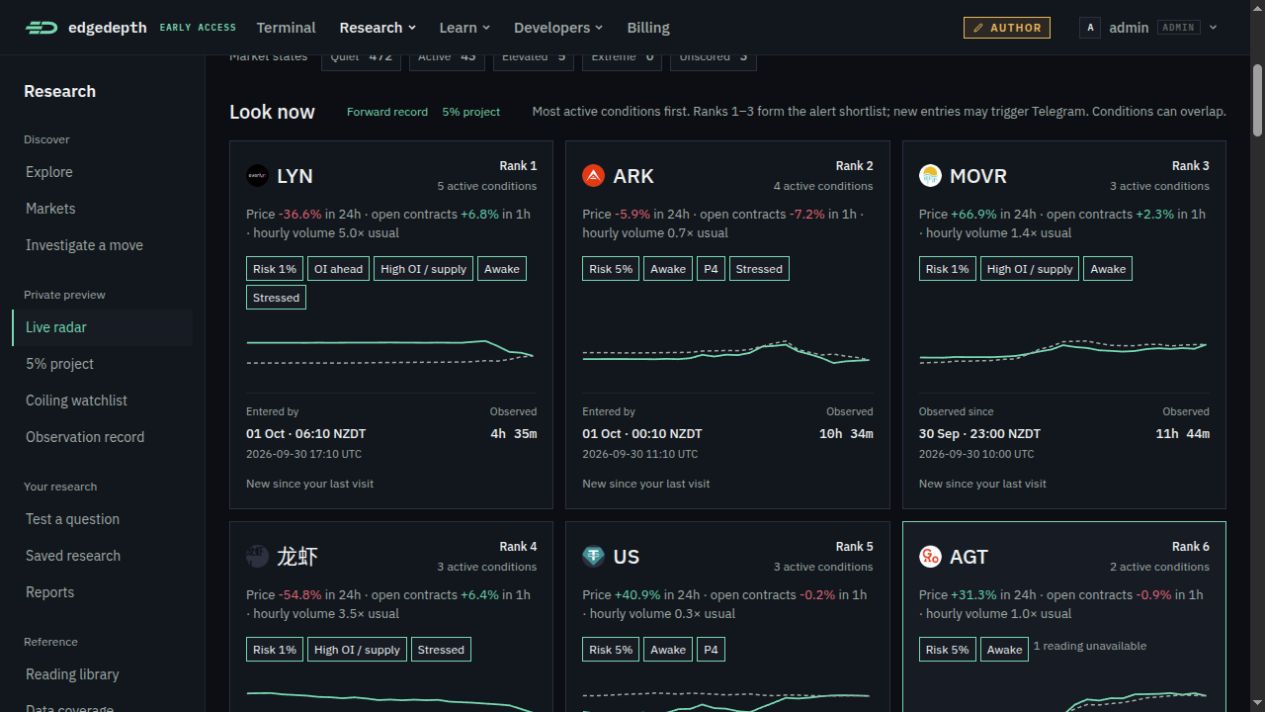
Start with markets showing active conditions, with price, open interest, funding and trading activity as context.
-
Inspect the context
See what triggered attention, when it was observed and which readings are missing or stale.
-
Test and revisit
Use the market and moment to frame a Research study. Compare recorded cases with a baseline, inspect failures and return to what followed.
Radar is the discovery step. Historical testing is a separate Research workflow; a shortlist does not automatically validate an idea.
Inside a market
See why a market reached the shortlist.
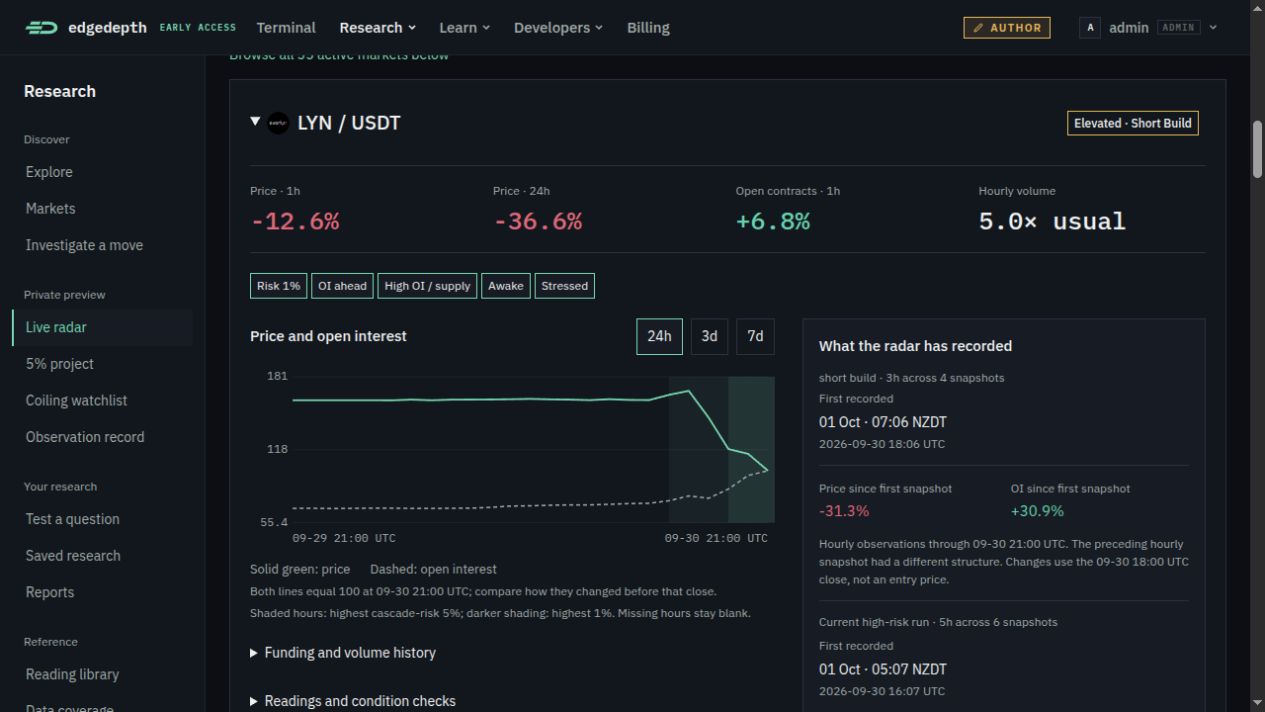
Open a market to compare price and open interest, inspect funding and volume, and see when its current structure first appeared in the recorded snapshots.
Open interest counts outstanding futures contracts. Funding is the periodic payment between long and short positions. Open interest guide · Funding guide
Live Radar explained
What the preview does.
What does this crypto market scanner look for?
Unusual trading activity, changes in open interest, elevated market stress and other active conditions across covered Binance USDT perpetuals. Each market shows the readings behind its place in the shortlist, including unavailable inputs.
How live is Live Radar?
The page checks for updates every 60 seconds while visible. Shortlist entry checks run every five minutes and cascade scores update hourly; other readings keep their own source clocks. Page refresh time and observation time are shown separately.
Does a high rank mean buy or sell?
No. Ranks organise attention, and several conditions can share the same cause. Radar helps you find a question. Research separately tests supported conditions against recorded cases and a baseline; neither establishes a future return.
READING THE PREVIEW
Keep the observation and its limits together.
Ranks organise attention
Active conditions describe observations. Overlapping flags are not independent confirmations, and a high rank does not establish a trade direction or expected return.
Freshness matters
Inputs update at different intervals, some hourly. A refreshed page may still show the same source observation. Timestamps, gaps and pending outcomes matter.
We are evaluating the detectors, ranking, data coverage and what happens after observations. The interface will change as we learn; no profitable trading strategy has been established by this preview.