DOM ladder & time and sales
Reading Binance and Hyperliquid BBO, ladder and tape as one order-flow column: native symbol-specific top of book, depth bars, grouping and large-trade highlights.
The DOM (depth of market) shows resting bids and asks per price level; the tape shows executed trades. EdgeDepth stacks them as one column on one price axis across 670 Binance USDT-M crypto perpetuals, plus eligible Hyperliquid crypto perpetuals, so your eye scans book and prints together. The live top of book comes from native-rate per-symbol Binance bookTicker plus sub-second per-coin Hyperliquid BBO, preserving every received best-bid and best-ask price and quantity change, preserved per symbol.
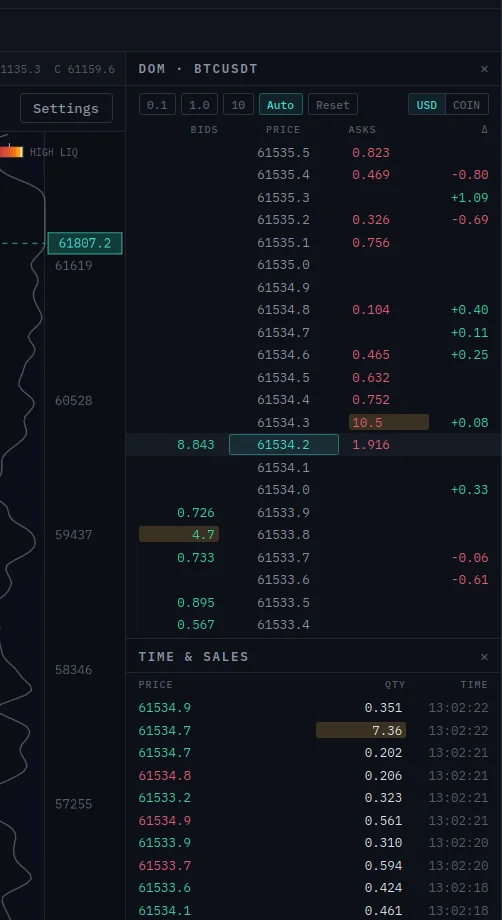
The ladder
- Bid sizes left, ask sizes right, with depth bars behind each size scaled to the visible book, so relative size reads instantly - a level three times thicker than its neighbors looks three times thicker.
- The spread row is pinned and highlighted: you always know where the market is, even scrolled deep into the book.
- The best bid and offer are symbol-specific: dedicated Binance bookTicker and sub-second per-coin Hyperliquid BBO updates drive the top of book instead of an occasional global summary sample.
- Price grouping - 0.1 / 1.0 / 10 tick buckets, or Auto. This is a zoom knob for the book: fine grouping shows the actual queue at each price (and reveals games played at single ticks); coarse grouping collapses noise into structure and shows you the walls. Flip between them; the book looks genuinely different at each scale, and both views are true.
- USD / COIN toggles whether sizes read as notional or base units. USD makes pairs comparable - 40 BTC and 400,000 DOGE stop being apples and oranges.
The tape
Each print shows price, size and timestamp, colored by aggressor side: who crossed the spread, not who was resting. Unusually large prints get a notional-scaled bubble and highlight, so one glance shows when someone is hitting the book with real size instead of drip-feeding an order.
The tape’s information is in its texture. Steady two-sided prints are a market at rest. A run of same-side prints, growing in size, with the highlights stacking up - that is someone who needs out (or in) more than they need a good price.
Reading them together
The column earns its place when you read book against prints:
- Absorption. Price presses into a level, the tape hammers it with market orders, and the level refuses to break - size refills as fast as it’s consumed. Someone is standing there on purpose. Levels that absorb are the ones worth marking.
- Evaporation. Bids cancelling ahead of price - thinning before the market even reaches them. Resting liquidity leaving early is often the tell before a flush: the tape hasn’t done anything yet, but the ladder has already voted.
- One-sided tape into thin book. When aggressive flow lines up with a book that has stopped replenishing, displacement gets easy. VPIN measures bucket imbalance separately; it does not measure book replenishment or establish why quotes changed.
- Resting size is a claim, not a commitment. Anyone can post size and pull it. Weight what executes (the tape, the absorption) over what merely rests. The ladder tells you where to look; the tape tells you whether to believe it.
Why it matters
A chart shows you that price moved. The column shows you how: bids evaporating before a flush, one-sided prints during a squeeze, absorption at a level that refuses to break. The current Binance replay preserves every book delta, per-symbol bookTicker update and print so you can study a cascade’s order flow repeatedly. Hyperliquid historical data has been backfilled. Historical research and replay are not yet publicly available; derived data and coverage still require validation.
Looking for a calculation? Open the Reading library. For recorded exercises, browse guided lessons.