The event archive
How events get named and archived, the seven categories, severity ticks, and why archived events outlive the 90-day window.
The archive is EdgeDepth’s permanent memory: a growing collection of selected named market events, each stored with its recorded order flow and a public page that states its replay access. It grows daily.
How an event gets in
Detectors watch all 670 pairs around the clock - for cascading liquidations, squeeze mechanics, macro-print volatility, outage gaps, and outsized moves generally. When one fires, the system archives the event’s available recorded streams. Inspect the event page for its recorded window, data availability and replay access. A named event does not by itself prove every underlying stream is complete.
Each event is then measured and labelled: a category with supporting evidence, severity, peak and net move, liquidated notional, duration. Related events that moved together - real co-movement, not same-hour coincidence - are clustered, so a sector-wide cascade reads as one story instead of forty separate cards.
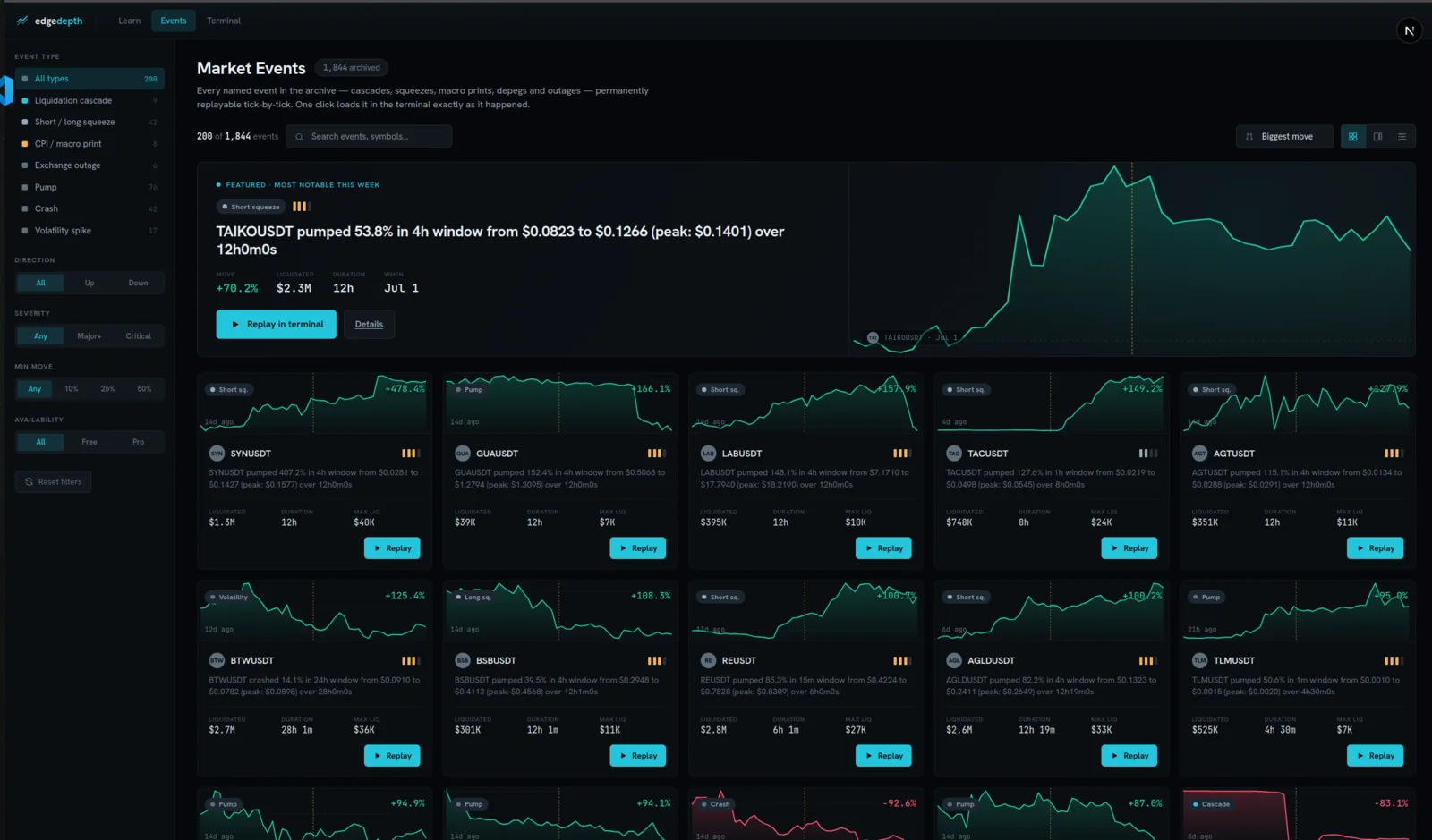
Categories
Seven types, filterable by direction, severity and minimum move:
- Liquidation cascade
- Short / long squeeze
- CPI / macro print
- Exchange outage
- Pump
- Crash
- Volatility spike
Category labels are evidence-based - an event is called a squeeze because the positioning and liquidation data say so, not because the candle looks like one. Where the mechanism can’t be established, the label stays an honest shape (“pump”, “crash”) rather than inventing a cause.
The cards
Every card carries the factual record: the move (e.g. +478.4%), a one-line description with prices and window, liquidated notional, duration, max single liquidation, a sparkline, and amber severity ticks (▮▮▮▯). The card opens the public event page, which labels replay access before sending you to the terminal.
The event pages
Every event also gets a permanent public page: the category and its confidence, peak versus net move, the data included in the bundle, and a key-moments timeline - first liquidation, liquidation peak, capitulation wick, volume climax - so you know what to watch for before you press play. Linkable, searchable, citable: when someone asks “what actually happened to that coin”, the answer is a URL with a replay button on it.
Permanence
The rolling replay window covers 90 days for Pro. Archiving pins an event permanently: its recorded order flow stays replayable beyond that window. Authenticated free users receive full event replay for eligible events inside the rolling 7 days event window, including the normal archived DOM and order-book updates. Administrator-selected public events remain free regardless of age, and explicit public demonstrations need no account. Older events require Pro unless marked public or free. Pro opens all available archived events. Authors also build guided lessons on top of archived events - when an event is in the curriculum, its page says so.
Selected examples and the complete record
The event archive remains a selected collection of important examples. It is not every historical occurrence of every possible setup. EdgeDepth Research is the complete-record counterpart: describe observable setup-time conditions and it scans every eligible minute in the chosen range, keeps later outcomes out of the predicate, and opens every matching historical window directly in replay. The archive tells a selected event’s story; Research tests how that story fits the wider record.
Looking for a calculation? Open the Reading library. For recorded exercises, browse guided lessons.